Hugh Masterton (fl. 1225 - 1235)
The First Masterton?
There is only one reference to Hugh (or Hugo) Masterton, who may well have been the fons et origo of the Masterton family lineage in Scotland.
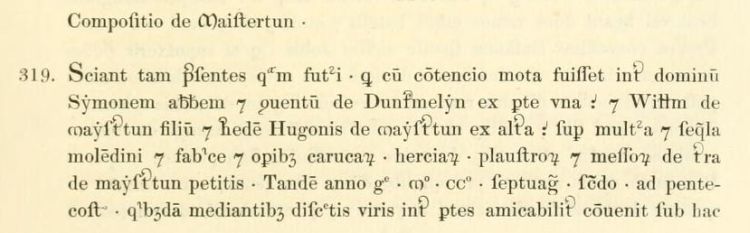
Hugo de villa magistri 1225 x 1235 Dunf. Reg. no. 171 [dates approximate]. The "villa magistri" is the latinised version of the "Master's town" so the estate he owned and from which he took his full name, was most likely Masterton (pronunciation probably "Maistertun").
Taylor and Markus define "Mastertown" (as it became) as 'The estate of the master', the eponymous master being Master Ailric the mason, fl. before 1153, presumably one of those in charge of building work at Dunfermline Abbey. It was given to Dunfermline Abbey by King Malcolm IV on the day of David I's funeral (24 May 1153) (RRS i no. 118).
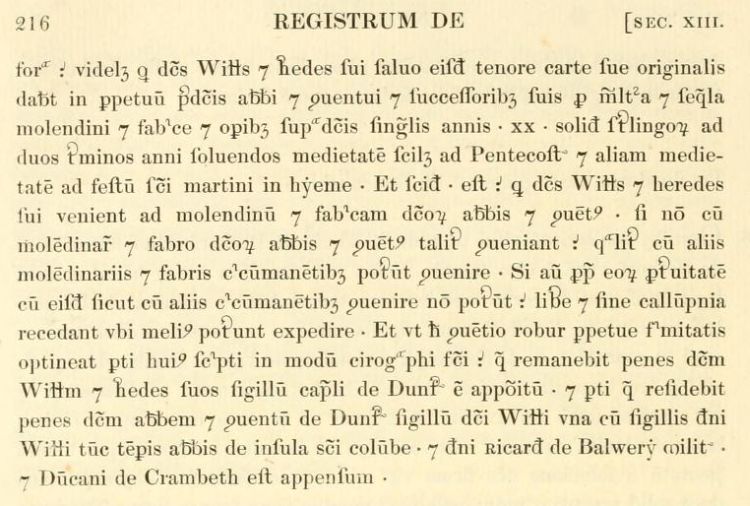
We can only speculate on Hugh's origins and how he came to occupy the lands of Masterton, but there may be some clues in contemporary events in 13th Century Scotland. We can deduce that Hugh acquired, or was granted leave to occupy, the estate lands from Dunfermline Abbey some time after 1153. His son William was seen to be sufficiently eminent to be asked to swear fealty to Edward I of England in 1296 (Inst. Pub.). So, the Mastertons in mid 13th Century were landed gentry of some stature, in favour with the King of Scots, (sufficently so to be obliged to sign the "Ragman Roll") and occupying lands formerly owned by the King and, later, one of Scotland's major religious foundations.
After the reign of David I (1124-1153) came Malcolm IV (1153-1165) who was succeeded by William I (1165-1214) then Alexander II (1214-1249) and Alexander III (1249-1286). What kind of people were in favour with the Scottish kings' courts at that time?
Ditchburn and Macdonald describe the court as "peopled by the king's counsellors and immediate retainers, men who exercised considerable influence or who were, at any rate, closely linked with the exercise of royal power. The composition of the king's household varied in personnel, but on the basis of charter evidence it mainly consisted of men of Anglo-French stock in the twelfth and thirteenth centuries, with 'native' appearances more irregular. As well as being cosmopolitan, the twelfth-century court was also a highly itinerant institution...and many royal rights were rendered in kind and consumed as the household moved around the kingdom. Just as the personnel attending the court tended increasingly to be 'foreigners', so the geographical location in which the king was to be found was, from the time of David I, mostly inclined to a heartland which was non-Gaelic. Favourite locations of the MacMalcolm kings varied from reign to reign, but the undoubted general inclination was towards the southern and eastern lowlands. This was the area that was most subject to the influences from the Anglo-French settlers.
..from the time of David I the king's retainers, closest companions and advisers inhabited a largely Anglo-French cultural world. An early thirteenth-century English chronicler was able to state, although perhaps not with total accuracy, that the kings of Scotland actually regarded themselves as Frenchmen and had reduced the Scots to servitude. Later, as Anglo-French incomers and native aristocrats intermingled, this sense of division was much less pronounced."
It's possible that Hugh and William were third or fouth generation descendants of the saxon Ailric, but that does not fit well with the lands being returned to Dunfermline Abbey in 1153. A more reasonable deduction might be that Hugh (or a close ancestor) was granted the lands of Masterton under royal patronage of Malcolm IV, William I or Alexander II, and that (since native magnates would already have their own lands) Hugh, or his ancestor, was an incomer from the French influx into England and Scotland after the Norman invasion. When he settled in Masterton, he then became "Hugh of Masterton".
Sources:
RRS i Regesta Regum Scottorum vol. i (Acts of Malcolm IV) ed. G.W.S. Barrow, Edinburgh 1960.
Dunf. Reg. Registrum de Dunfermelyn, Bannatyne Club 1842.
Inst. Pub. Instrumenta Publica sive Processus super Fidelitatibus et Homagiis Scotorum Domino Regi Angliae Factis 1291-96, Bannatyne Club 1834 [Ragman Roll].
Taylor and Markus, The Place-Names of Fife. Volume One. West Fife between Leven And Forth. Simon Taylor with Gilbert Markus (Shaun Tyas, Donington, 2006).
Ditchburn and Macdonald, Medieval Scotland, 1100-1560; in The History of Scotland ed R.A. Houston and W.W.J. Knox. Penguin, 2001